
CHAPTER ONE – WHAT IS TREE ROOT SUBSIDENCE?
- Introduction
Before looking at tree root subsidence, this book begins by considering what subsidence damage actually is.
Subsidence is defined by the Financial Ombudsman Service as “the downward movement of the site on which a building stands, where the soil beneath the building’s foundations is unstable. This movement can occur due to various factors, including changes in moisture levels or the weight of the building itself.”
Tree root (or vegetation related) subsidence is the downward movement of the site on which the building stands caused by the influence of tree roots on the moisture content of the soils underlying the property foundations. Clay soils cause subsidence primarily due to their ability to absorb and release moisture leading to seasonal shrinking and swelling. The soil swells in the winter period as the weather is wetter and trees have a lower water demand and then shrink over the summer as roots take up water from the soil in the course of transpiration.
Where roots from a tree have grown underneath the foundations of a property built on clay shrinkable soil, the drying effect can be enough to cause differential movement of the property. Where the movement is significant enough it can cause windows and doors to ‘stick’ and cracking to appear. In the worst case scenario, the damage can be significant enough to cause instability of the structure and demolition of a property can be required in rare situations.
Tree root subsidence is wholly linked to our weather. The number of episodes of subsidence damage will be higher after a hot and dry summer. A year with an above average number of these claims is labelled a ‘surge’ or ‘event’ year. With climate change impacting the UK, these event years are becoming more common.
- A history of insurance cover
In the insurance industry subsidence damage is what is known as an ‘insured peril’, i.e., an event or risk that is covered under an insurance policy.
Subsidence damage has not always been covered as standard by insurance in the UK. As a result of the surge in claims from the summer of 1976 pressure grew on the insurance industry to step in and deal with those claims. Pressures included:
- The scale of claims – Tens of thousands of properties across the South East of England were affected at once, showing that subsidence was not a niche problem.
- Public and political pressure – Media coverage of distressed homeowners and MPs raising subsidence as an issue before parliament put the insurance industry under pressure.
- Consumer expectations – Homeowners who had paid for buildings insurance assumed that it would provide cover for this structural damage.
- Market competition – Some insurance companies started to offer subsidence cover as standard, leading to market competition.
- Legal pressure – Policy disputes led to litigation risk for insurance companies.
- Development on shrinkable soils – The scale of housing development in areas underlain by a clay soil means that this was an issue of increasing risk as more properties were built in subsidence prone areas.
- Regulatory and industry guidance – The Association of British Insurers began pushing for clearer, fairer treatment of subsidence claims and urging consistency by their insurer members.
- Risk spreading – Insurers were able to assess and spread the risk to manage their financial exposure using policy excesses, insurance conditions and reinsurance.
From 1976 onwards subsidence has been underwritten by insurers as part of their mainstream buildings insurance offering.
- Climate Change & Data
The impact of climate change is a growing concern in the area of tree root subsidence.
Tree root subsidence is the only peril which is made worse by climate change and where the traditional approach to remedy a claim can be to fell an implicated tree which, in turn, contributes towards making climate change worse.
In the UK as our summers are getting hotter and drier, the conditions conducive to tree root subsidence risk are becoming more common. As our climate changes, subsidence claims are appearing in parts of the UK which have historically been too mild or wet to experience much tree root subsidence.
Event years are getting more common. Having occurred in 1976, 1983, 1989-1991, 1995, 2003, 2006, 2018, 2022 and with 2025 about to be declared an event year.
In the last surge event of 2022 the Association of British Insurers (ABI) reported 23,000 subsidence claims costing the insurance industry £219m with an average claim cost of £9600. The hot summer of 2025 is yet to be declared an event year (as at the time of writing) but this looks likely. This surge however sees an increase in the average spend per claim up to over £17,000 as the higher cost of materials impacts insurance claim cost.
- Insurance risk profiling and postcode analysis
Insurance companies assess risk by using data relating to past claims. Reflecting back on data where we are moving forward in a changing climate can risk making inaccurate assessments.
Increasingly insurance companies are relying on a variety of sources of data to assess subsidence risk. From soil and geology maps, met office climate data, historical claims data, remote sensing and satellite imagery, tree and vegetation databased, property age and construction type, water company data and geospatial risk tools.
These sources can come together in a postcode-based assessment. Properties in ‘high risk’ areas, such as parts of North London, Surrey and Kent can be deemed a high risk due to a number of factors being present which might make a property prone to subsidence damage. In those areas higher insurance premiums may be charged to reflect the insurance risk. In other cases, policies may not be offered to properties given their risk level.
Whilst I cannot credit this statistic to a particular industry expert, it is accepted that even in the highest risk areas, no property has more than a 5% chance of suffering from subsidence damage due to a tree. In the industry others have commented that 5% is a generous figure and actually this % risk is far closer to a 1 or 2% chance.
Due to a reliance on data, there is a fast-emerging industry in modelling and data to help and support insurance companies in this assessment.
Not only can this data help insurance companies but it is also of interest to property buyers. This data allows buyers to make informed decisions on risk when buying a property and to the mortgage industry focused on maintaining the value of the property against which their mortgage loan is secured.
- The role of insurers and their supply chain
When a homeowner notices crack damage to their property and makes a claim on their insurance policy, the claim is typically managed by the insurance company’s specialist suppliers. There are a number of such suppliers in the industry who provide a subsidence specific service to insurance companies, manage the claim from its first notification stage (FNOL) through to conclusion, and even legal recovery claim.
In broad terms the claim process follows these key steps:
- First notification of loss – Claim notified by the homeowner to the insurer and the insurer instructs one of their suppliers
- Initial assessment – The supplier carries out their initial assessment of the damage to start the process of verifying whether the damage is subsidence and whether the claim should be accepted under the policy.
- Site investigations – A suite of site investigations are carried out in order to determine the soil type and condition and the presence or not of roots under the foundations. Drainage investigation will also be carried out to rule out leaking drains as a cause of the subsidence.
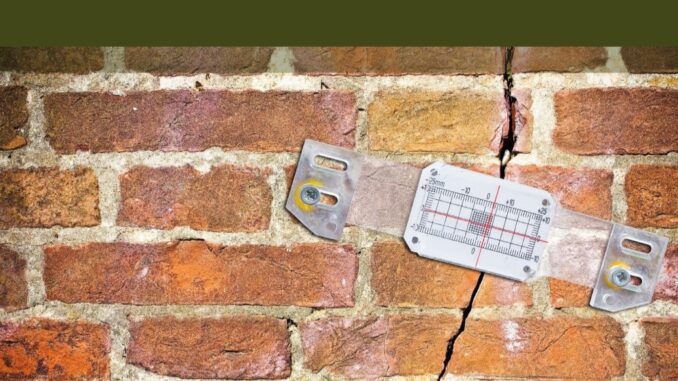
- Monitoring – The property can be monitored by way of crack monitoring or level monitoring and distortion survey. The purpose of monitoring being to review the pattern of movement of the property, with the up (winter) and down (summer) pattern being indicative of the influence of vegetation.
- Remote investigation – The Covid pandemic, the increase in reliance on remote/satellite technology and the ability to tap into a data banks from past claims is seeing the increase in remote site investigations and analysis.
- Arboricultural assessment – Where investigations indicate that the property has suffered damage as a result of the impact of vegetation, an arboricultural investigation will go ahead to assess which trees might be implicated in the damage.
Once this evidence has been gathered, the insurers will be able to review the conclusions of their supplier and insurance cover will either be accepted or rejected.
If the claim is accepted under the subsidence peril the claim moves to the next stage: mitigation (Chapter 3).